
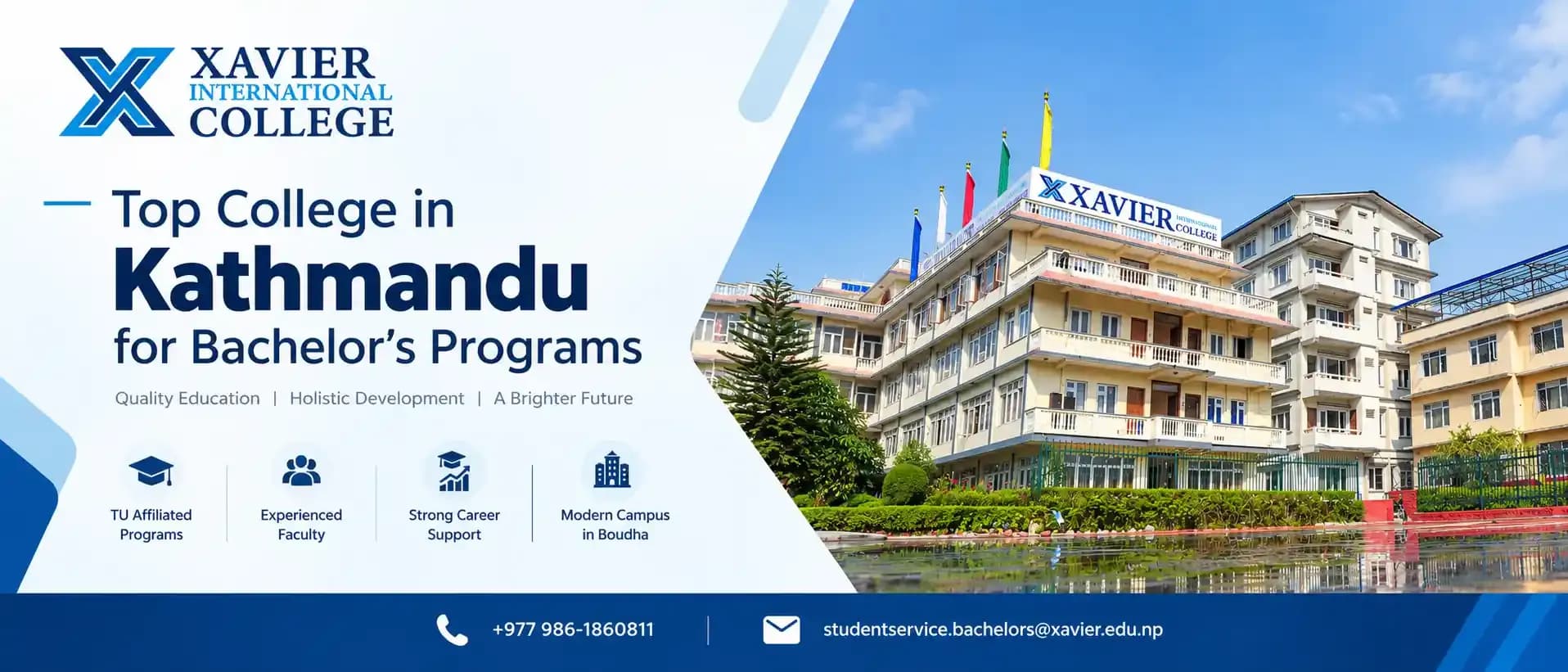
Choosing the right college for a bachelor’s degree in Kathmandu requires evaluating program options, university affiliations, total costs, faculty quality, and hands-on learning opportunities rather than relying on popularity alone. This complete guide breaks down how to compare undergraduate programs across IT, Management, Science, and Social Work—explaining university systems in Nepal, key factors to consider when visiting campuses, and how institutions like Tribhuvan University-affiliated Xavier International College combine practical skill-building, industry partnerships (IBM, Dursikshya, Knowlary), transparent fee structures, and early-bird scholarship support to prepare students for successful careers.
Choosing where to study for a bachelor's degree is an important decision. The college you choose will influence your academic experience, the people you learn with, the opportunities available to you, and how prepared you feel for the next stage of your career.
Kathmandu Valley offers a wide range of colleges and undergraduate programs. Students can choose from Management, Information Technology, Science, Social Work, and other fields under different universities and academic systems. With so many options available, choosing the right college requires looking beyond its name or popularity.
The best choice depends on what you want to study and what matters most to you. The right program, university affiliation, teaching environment, practical opportunities, campus life, location, and fees can all play a role in your decision.
This guide explains how to compare colleges in Kathmandu and make a more informed choice for your bachelor's degree.
Start With the Bachelor's Program You Want to Study
Before comparing colleges, first decide what you want to study.
Your choice of program should be connected to your interests, strengths, and future plans. A student interested in technology may have very different priorities from someone planning to study management, science, or social work.
For example, students interested in computers and technology may consider programs such as BCA or BSc CSIT. Those interested in business and management may explore programs such as BBM, BBA, or BBS. Other students may be more interested in areas such as microbiology, environmental science, or social work.
The program name alone should not determine your decision. Take time to understand what you will actually study throughout the degree.
Look at the curriculum and ask questions such as:
- What subjects will I study?
- Does the program include practical work or projects?
- What skills can I expect to develop?
- What career paths can the degree support?
- Does the program match my long-term interests?
Students considering different fields can begin by exploring the available bachelor's programs and then compare the colleges that offer the program most relevant to their goals.
Once you know what you want to study, it becomes much easier to compare your options.
Understand the University Affiliation
University affiliation is an important factor when choosing a college in Nepal.
The university generally determines the broader academic structure of a program, including its curriculum, examinations, credit requirements, and degree standards. The college, however, plays an important role in how students experience that education through teaching, facilities, academic support, activities, and practical opportunities.
Understanding the main university options can help you narrow down your choices.
Tribhuvan University
Tribhuvan University is Nepal's oldest and largest university and has a broad network of constituent and affiliated colleges throughout the country.
It offers undergraduate programs across a wide range of fields, including management, humanities and social sciences, science and technology, and other disciplines.
For students considering a TU-affiliated college, the university affiliation is only one part of the decision. Colleges offering programs under the same university can still provide very different student experiences.
When comparing TU-affiliated colleges, look at the individual institution as well. Consider its faculty, academic environment, facilities, location, student activities, and the support available throughout your studies.
Kathmandu University
Kathmandu University is another major option for students pursuing higher education in Nepal. It is particularly known for programs in areas such as Engineering, Science, Management, Medicine, and other professional disciplines.
Students interested in Kathmandu University programs should review the specific course structure and admission requirements carefully. Academic systems, assessment methods, and program requirements can differ from those of other universities.
Rather than choosing based only on the university name, look closely at whether the particular program matches your interests and future plans.
Pokhara University
Pokhara University offers undergraduate and postgraduate programs through its constituent and affiliated institutions.
It has programs in areas including Management, Information Technology, Health Sciences, and other professional fields. Students comparing Pokhara University-affiliated colleges should examine the specific program they are interested in and understand how academic activities, assessments, practical work, and projects are structured.
The individual college also matters, particularly when it comes to the learning environment and opportunities available outside the prescribed curriculum.
Purbanchal University
Purbanchal University also offers a range of academic programs through affiliated institutions in Nepal.
Students can find programs in areas such as Management, Science and Technology, Health Sciences, and other disciplines. As with other university affiliations, students should compare the specific program and the college delivering it rather than making a decision based solely on the university name.
Understanding the curriculum and speaking with the college can help students determine whether the program is suitable for their goals.
International University Affiliations
Some colleges in Kathmandu also offer degrees affiliated with universities outside Nepal.
These programs may follow different academic structures, assessment systems, and curricula. They can be suitable for students interested in a particular international program or learning model.
However, students should carefully understand the full details before enrolling. This includes the total cost of the degree, recognition of the qualification, academic requirements, and the opportunities available after graduation.
An international affiliation does not automatically make one option better than another. The value of the program depends on whether it genuinely matches your academic and professional goals.
Compare Colleges Offering the Same Program
After choosing a program and understanding your preferred university options, you can begin comparing individual colleges.
This is where it is important to look beyond advertisements and broad claims about being the best. Colleges offering the same degree may follow the same university curriculum, but the overall student experience can still be very different.
Compare what each college actually provides.
Look at the academic environment, teaching approach, learning resources, practical opportunities, and support available to students.
Some useful questions include:
- Who teaches the program?
- What is the classroom environment like?
- How are students encouraged to participate and learn?
- Are projects and practical activities part of the experience?
- What academic support is available?
- Are workshops or expert sessions organized?
A good college should provide a learning environment where students can understand their subjects properly and develop beyond simply preparing for examinations.
Look at the Faculty and Learning Environment
Teachers play a major role in the quality of a student's academic experience.
When comparing colleges, find out about the faculty members involved in your chosen program. Look at their academic background, professional experience, and the areas in which they teach.
Professional experience can be particularly valuable in programs connected closely with industry, while strong academic guidance is important across every field.
You should also consider the overall learning environment.
A good academic environment encourages students to ask questions, participate in discussions, work on projects, and seek guidance when they need it. The relationship between students and faculty can make a significant difference during several years of undergraduate study.
If possible, visit the college and speak with current students about their classroom experience.
Check Whether the Facilities Support Your Program
The facilities that matter most will depend on what you plan to study.
A student studying computer applications may need access to appropriate computer and technology resources. Science students may need laboratories and practical facilities. Students in management and other fields may benefit from libraries, presentation spaces, workshops, and other learning resources.
When visiting a college, look beyond how the campus appears at first glance.
Consider whether students actually have access to the facilities they need.
Check areas such as:
- Classrooms and learning spaces
- Libraries and study resources
- Computer laboratories
- Science or specialized laboratories
- Digital learning resources
- Internet access
- General campus environment
The most important question is whether the facilities contribute meaningfully to the learning experience.
Look for Practical Learning Opportunities
Academic knowledge provides the foundation of a bachelor's degree, but practical experience can help students understand how that knowledge is applied.
Depending on the program, practical learning may include projects, presentations, laboratory work, workshops, field activities, industry interaction, or other hands-on experiences.
These opportunities can help students build confidence and develop skills that may be useful after graduation.
When comparing colleges, ask how students are encouraged to apply what they learn in the classroom.
For students interested in computer applications, for example, practical work and projects can be an important part of developing technical skills alongside academic knowledge. Students considering a BCA degree should therefore look carefully at the learning opportunities available in addition to the prescribed curriculum.
The same principle applies to every field. Understanding theory is important, but opportunities to apply that knowledge can make the learning experience more meaningful.
College Life Matters Too
A bachelor's degree is about more than lectures, assignments, and examinations.
Students spend several important years at college, and the experiences they have outside the classroom can also contribute to their personal and professional growth.
Events, student activities, sports, cultural programs, competitions, clubs, and opportunities to work with other students can help develop communication, teamwork, leadership, and confidence.
These experiences also allow students to build friendships and become part of a wider student community.
When comparing colleges, consider the overall environment and whether students have opportunities to participate beyond their academic schedule. The academic experience and student life at Xavier International College are shaped not only by regular classes but also by opportunities for students to take part in activities and experiences throughout their college years.
A college environment that encourages participation can help students develop skills and confidence that are difficult to gain from textbooks alone.
Consider Career Preparation and Industry Exposure
For most students, a bachelor's degree is connected to what comes next.
Some students plan to enter employment after graduation. Others may continue with postgraduate education, start a business, or pursue professional opportunities in a specific field.
The college experience should therefore help students prepare for these possibilities.
Depending on the program, useful opportunities may include internships, professional workshops, guest lectures, industry interaction, practical projects, and career guidance.
When comparing colleges, ask questions such as:
- Does the program provide practical exposure?
- Are students introduced to professionals working in relevant fields?
- Are internships available?
- Does the college organize career-related workshops?
- Are students encouraged to develop professional skills?
The type of opportunity will naturally vary between programs. What matters is whether the college makes an effort to connect academic learning with the realities of the field students are preparing to enter.
Compare Fees and Financial Support Carefully
The cost of higher education is an important consideration for students and their families.
When comparing colleges, avoid looking only at the total fee. Understand what is included and whether there are additional expenses throughout the degree.
Ask about:
- Tuition fees
- Admission and registration charges
- University-related fees
- Examination fees
- Laboratory or practical charges
- Scholarships
- Payment arrangements
Scholarships can also make a significant difference when choosing a college. Students should ask about the eligibility criteria and understand what type of financial support may be available.
The goal is to understand the overall value of the education you are receiving and whether it fits your financial circumstances.
Visit the College and Speak With Students
A website can provide useful information, but visiting a college can help you understand the environment more clearly.
If possible, visit the campus before making your final decision. Look at the classrooms and facilities, understand the location, and speak with the admissions team about your chosen program.
It can also be useful to speak with current students.
They can share their experiences of attending classes, interacting with teachers, participating in activities, and managing everyday college life.
You do not need to make your decision based on one person's opinion. However, speaking with several students can give you a broader picture of the actual experience.
How to Make Your Final Choice
After researching different options, create a shortlist and compare the colleges based on the factors that matter most to you.
Your comparison may include:
- The bachelor's program offered
- University affiliation
- Curriculum and academic structure
- Faculty and teaching environment
- Facilities and learning resources
- Practical learning opportunities
- Industry exposure
- Student activities and college environment
- Location and daily commute
- Fees and scholarships
Different students will prioritize these factors differently.
Someone interested in a technology career may place greater importance on practical projects and technical learning opportunities. Another student may prioritize a particular academic program, affordability, location, or the overall campus environment.
There is no single answer that works for everyone. The right college is the one that fits your academic interests, circumstances, and plans for the future.
Why Consider Xavier International College for Your Bachelor's Degree?
When comparing colleges, students should consider the complete experience they will receive throughout their undergraduate years.
Xavier International College is a Tribhuvan University (TU)-affiliated college located in Boudha/Tushal, Kathmandu. Xavier offers bachelor's programs including BCA, BBM, BBS, BASW, BSc Microbiology, and BSc Environmental Science, combining academic learning with practical exposure and student development.
Practical Learning and Industry Exposure
Learning at Xavier goes beyond regular classroom teaching through practical activities, workshops, expert sessions, and industry interaction. The college has collaborations with organizations including Annapurna Byte Nepal, Dursikshya, Knowlary, and IBM, giving students exposure to professional practices and emerging fields.
Scholarships and Fee Support
Xavier provides scholarship and early-registration schemes for eligible students. Depending on the intake and applicable scheme, early applicants may receive scholarships ranging from Rs. 1,00,000 to Rs. 1,77,777, while other early-registration offers can provide fee waivers of up to Rs. 1,50,000. Students should check the current terms and eligibility when applying.
Note: This is only valid for the admission year 2026
Events and Student Life
College life at Xavier extends beyond academics. Recent events have included the Graduation Ceremony, Dashain Fest, Environment Day Celebration, Cultural Day, Holi Utsav, and Xavier Olympics, giving students opportunities to participate in cultural, social, and sporting activities alongside their studies.
Preparing for Life After College
Through practical learning, professional exposure, student activities, and career-focused opportunities, Xavier aims to help students build skills for further education, internships, and employment after graduation.
Located in Boudha/Tushal, Kathmandu
For students considering undergraduate education in Kathmandu, location is another practical factor.
Xavier International College's bachelor's programs are based in the Boudha/Tushal area of Kathmandu. Students can consider the location alongside factors such as their daily commute, accessibility, and the overall environment they want during their undergraduate years.
The best way to decide whether a college is right for you is to understand the program, visit the environment, and compare it with your own priorities.
Bachelor's Campus: Boudha/Tushal, Kathmandu, Nepal
Contact Admissions: +977 986-1860811
Email: studentservice.bachelors@xavier.edu.np
Website: www.xaviercollege.edu.np